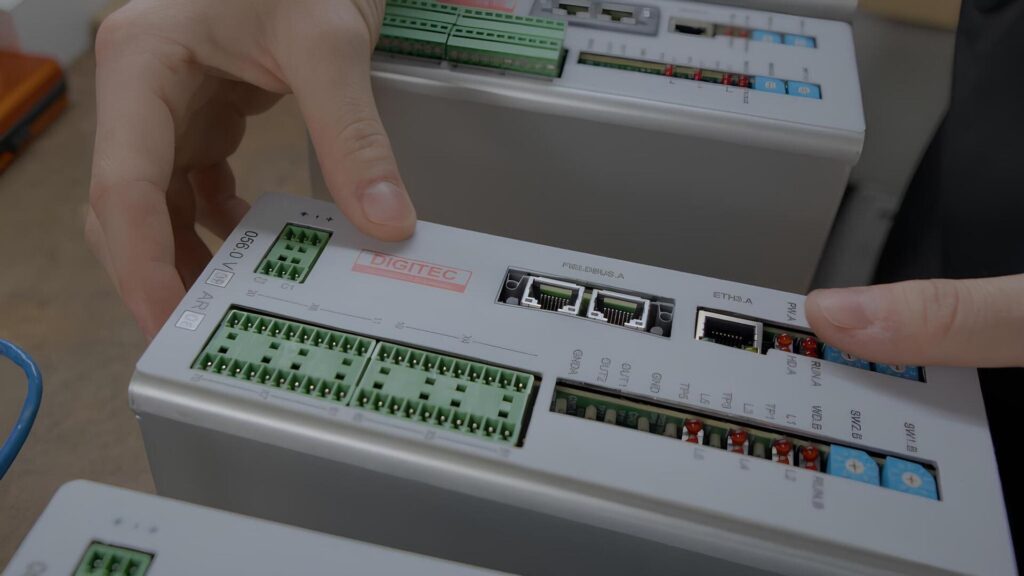
Over the years, Digitec has developed a strong technical and design versatility that enables it to apply advanced automation systems across a wide range of diverse fields. In this article, we explore the main sectors where Digitec’s automatic control systems are setting new standards for efficiency.
Metalworking and steel industry
In metalworking, the challenge is to combine mechanical power with the precision of electronic control. We specialize in:
- Sheet metal processing. We integrate control systems for flying and rotary shears, ensuring clean cuts without ever interrupting the line’s flow. We manage feeders and slitters with extreme precision, optimizing the positioning and trimming of coils.
- Metallurgy and profiling. Digitec provides solutions for profiling lines and flying shears that enable the production of perfect profiles at high speeds. We complete the automation with systems for tube and profile bundlers, automating the final stage of the production chain.
Paper and cardboard sector
The paper and cardboard sector requires very rapid response times to avoid wasting valuable material.
- We design and upgrade controls for high-performance cutters and entire corrugated cardboard production lines.
- We provide controls for paper processing systems, where synchronization between the various rollers is essential to maintain constant tension and prevent breaks.
Special solutions: insulation and palletizing
We also solve specific problems in niche markets.
For the building services sector, we handle the automation of systems for the production of insulation panels, where dosing and cutting precision are essential.
For logistics and food & beverage, we offer advanced systems for bottle handling and palletizing.
For industrial screen printing, we provide register and speed controls for screen printing presses on various substrates.
Flexographic and rotogravure printing sectors
For the flexographic and rotogravure printing sectors, Digitec offers targeted upgrades to restore competitiveness to existing systems with minimal impact on operational continuity. Many flexographic and rotogravure systems, while maintaining excellent mechanical robustness, suffer from electronic obsolescence. Our focus is on surgical interventions that target the technological heart of the machine:
- replacement of critical components. We identify at-risk components (such as discontinued motors or obsolete proprietary boards) and replace them with state-of-the-art technologies.
- Advanced software integration: the limiting factor is often not the mechanics, but the software’s ability to interface with modern management systems (Industry 4.0).
- Modularity of the upgrade. We design the upgrade so that it can be carried out in phases, allowing production to resume as quickly as possible.
1. Flexographic printing
Our upgrades focus on film tension control, implementing load cells and high-response drives to eliminate register fluctuations. Automated sleeve change, reducing setup time through more intuitive operator interfaces (HMIs).
2. Rotogravure printing
In rotogravure presses, stability over long runs is critical. We focus on shaftless systems, with conversion or optimization of electronic synchronization between the printing cylinders. We also focus on drying efficiency, with upgrades to ventilation and temperature control systems to reduce energy consumption, one of the major costs in this sector.
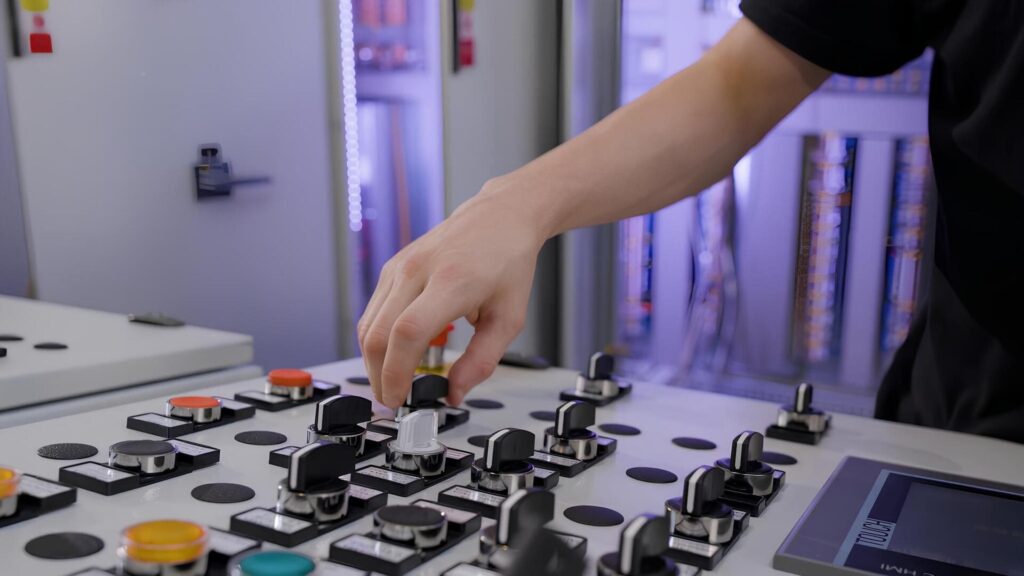
Processing moving materials: the Digitec solution
Digitec’s true added value shines in the most challenging applications—those requiring the processing of materials in constant motion. Thanks to the use of state-of-the-art electronically controlled motors, we ensure perfect synchronization between the machine’s components.
In particular, we specialize in:
On-the-fly cutting
We enable the machine to cut the material as it moves at maximum speed, instantly calculating the blade’s trajectory and speed for a perfect result without stoppages.
Pattern and mark recognition
Using advanced sensors and software, our systems recognize graphic references or marks on the material, triggering the next processing step (cutting, die-cutting, folding) with an error tolerance close to zero.
Multi-axis electronic synchronization
We coordinate multiple motors to work as a single unit, eliminating mechanical play and reducing component wear.